Quick summary
Red Teaming training at Best Cybersecurity Training in Hyderabad is a advanced classroom course in Ameerpet, Hyderabad, in our Offensive Security track. It covers 8 modules — red team operations, infrastructure, initial access, execution and persistence and more — with hands-on labs using tools such as Sliver / Mythic, BloodHound, Impacket. It suits experienced penetration testers moving to red team work.
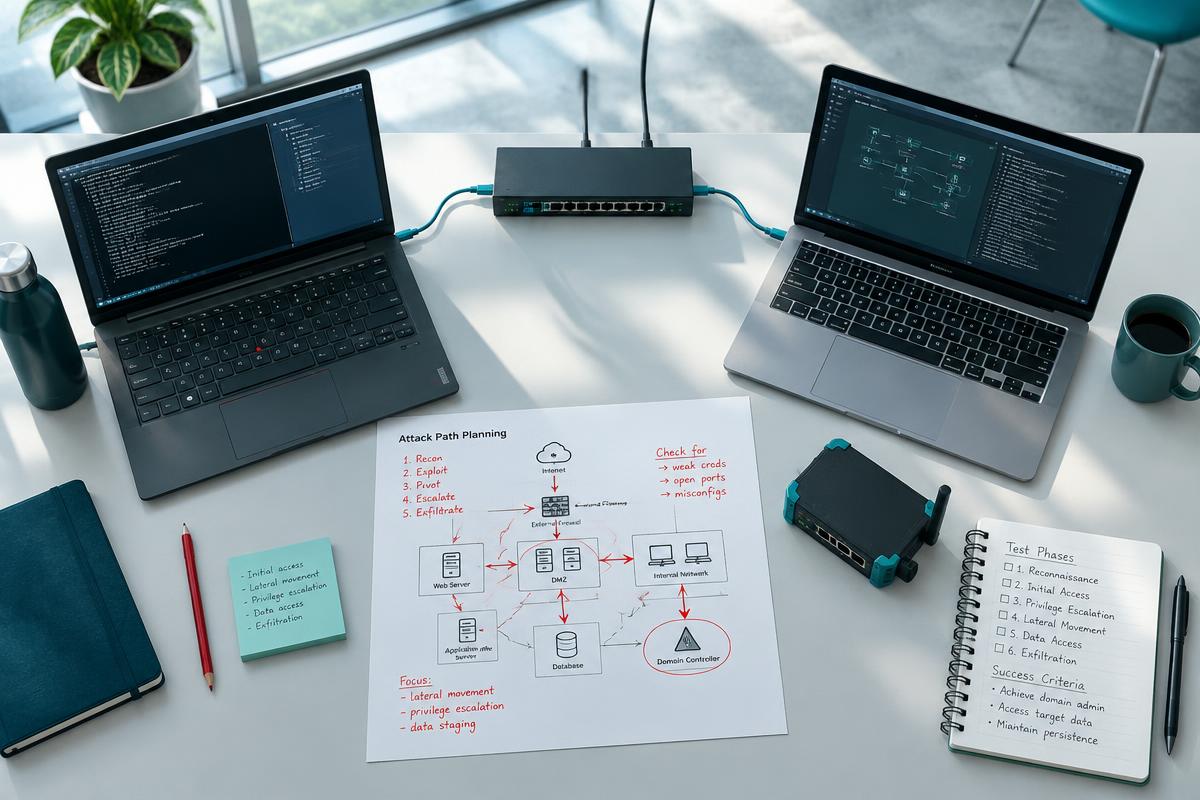
What is the Red Teaming course?
A red team engagement measures detection and response, not patch levels. Objectives are goal-based, stealth matters, and success is defined by what the blue team did or did not notice.
The course covers the full operation: planning against a threat profile, initial access, establishing resilient command and control, moving laterally, achieving the objective, and reporting in a way that improves defence.
Evasion is taught conceptually and practically within a lab containing real detection tooling, so you learn why a technique is caught rather than collecting bypasses that expire.
Who should learn this?
- Experienced penetration testers moving to red team work
- Security consultants running adversary emulation
- Purple team practitioners on the offensive side
- Defenders who want to understand sophisticated attacker tradecraft
Prerequisites
- Solid penetration testing experience
- Active Directory attack knowledge
- Scripting ability in PowerShell or Python
What you will learn
Red Teaming curriculum
M01
Red team operations
- Red team versus penetration test
- Threat profiling and emulation plans
- Objectives and success criteria
- Rules of engagement and deconfliction
M02
Infrastructure
- C2 framework selection
- Redirectors and domain categorisation
- Operational security for operators
- Logging your own activity
M03
Initial access
- Phishing design and pretexting
- Payload delivery considerations
- Exposed service abuse
- Physical and social vectors awareness
M04
Execution and persistence
- Living off the land
- Persistence that survives response
- Defence evasion concepts
- Application control bypass principles
M05
Active Directory operations
- Enumeration without noise
- Credential access techniques
- Kerberos attacks
- Delegation and trust abuse
M06
Lateral movement and objectives
- Movement technique selection
- Data location and staging
- Objective completion
- Impact demonstration within scope
M07
Detection awareness
- What EDR and SIEM see
- ATT&CK mapping of operator actions
- Tradecraft adjustment
- Purple team collaboration
M08
Reporting and debrief
- Attack narrative construction
- Detection timeline
- Defensive recommendations
- Replay and purple team workshop
Practical training
You run a multi-week simulated operation against a monitored lab environment with defenders watching, then debrief jointly on what was detected and when.
Tools and technologies
- Sliver / Mythic
- BloodHound
- Impacket
- Rubeus concepts
- Sysmon and EDR telemetry
- MITRE ATT&CK Navigator
Labs and projects
- Build and operate resilient C2 infrastructure
- Achieve initial access through a crafted phishing scenario in the lab
- Complete an objective in a monitored Active Directory environment
- Deliver an operation report with an attack and detection timeline
Learning outcomes
- Plan and execute a goal-oriented adversary emulation
- Operate with awareness of defensive telemetry
- Articulate findings as detection gaps, not just vulnerabilities
- Work constructively with blue teams in purple team exercises
Career relevance
Roles where these skills are directly used:
- Red team operator
- Adversary emulation specialist
- Senior penetration tester
- Offensive security consultant
Red Teaming training — FAQs
Is red teaming suitable for beginners?
No. It assumes working penetration testing skill, especially in Active Directory. Start with penetration testing and build from there.
Will I learn EDR bypasses?
You learn the principles of evasion and why specific actions are detected. Specific bypasses are perishable; understanding telemetry is not.
Is purple teaming included?
Yes. The debrief is run jointly with the defensive side, which is where most of the learning value sits.
Which C2 framework is used?
Open source frameworks such as Sliver and Mythic, so the skills remain practisable after the course.
Related cybersecurity courses

Ethical Hacking
Learn attacker technique the way defenders need it documented.
View curriculum
Penetration Testing
Technique inside a defensible, repeatable engagement process.
View curriculum
Threat Hunting
Assume the alert never fired. Go and look.
View curriculum
Blue Teaming
Build the defences, then prove they detect real technique.
View curriculum